Puppy Training Tips for Beginners: The Full Guide
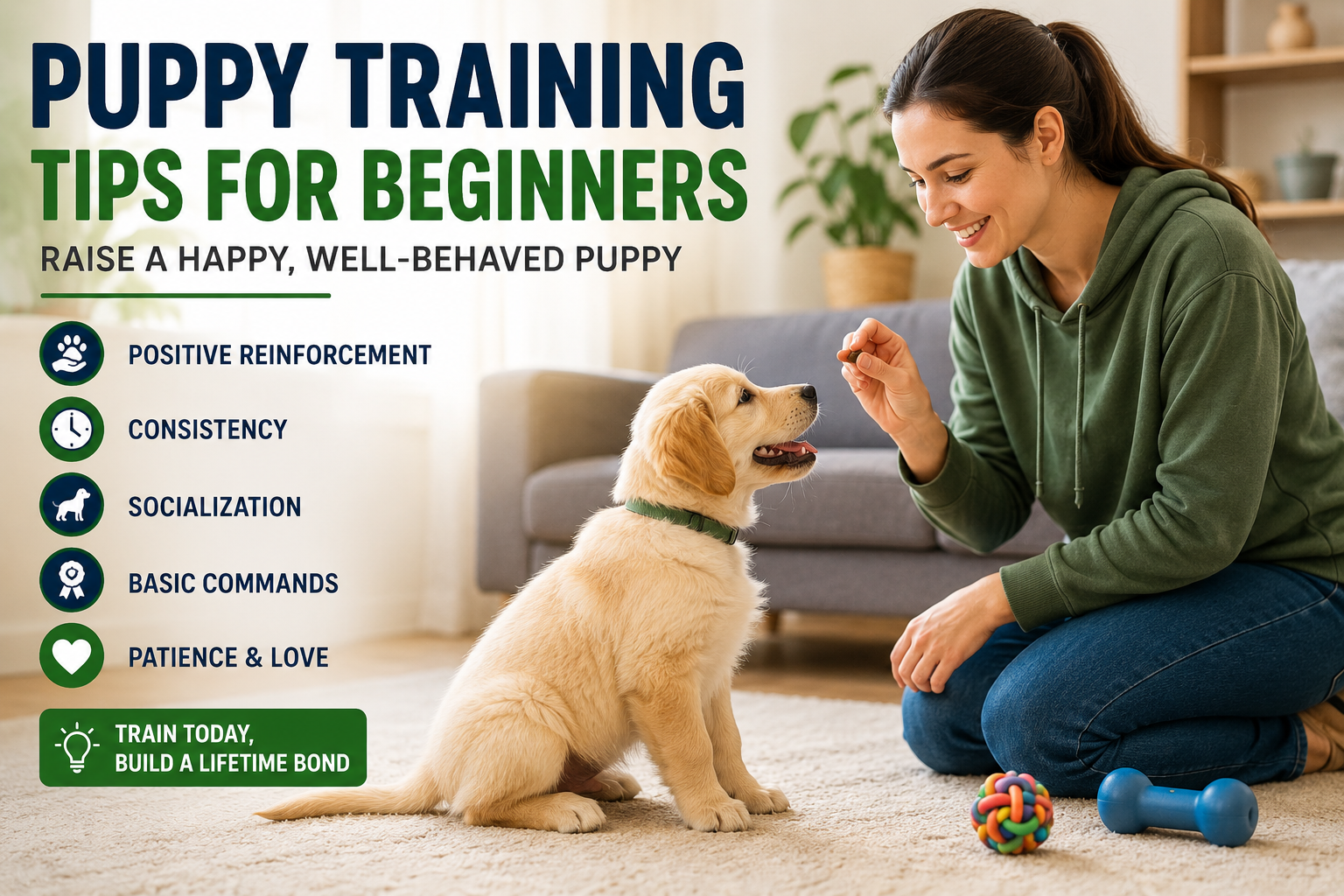
Puppy Training Tips for Beginners
If you just brought a puppy home, congratulations, and also, brace yourself. The next few months are going to be messy, exhausting, and honestly pretty magical. These puppy training tips for beginners come from years of raising, fostering, and troubleshooting puppies of every temperament, from the stubborn terrier who refused to sit for anything less than roast chicken to the golden retriever who learned “stay” in an afternoon.
Here’s the truth nobody tells new puppy owners: training isn’t about having a “smart” dog or being some kind of natural. It’s about consistency, patience, and knowing which battles actually matter. This guide walks you through everything, from the first week home to building a routine that sticks.
Table of contents
- Why puppy training matters
- When should you start training a puppy?
- Essential puppy training tips for beginners
- Common puppy training mistakes
- Recommended training schedule
- Essential puppy training supplies
- Frequently asked questions
- Final thoughts
Why puppy training matters
A puppy isn’t born knowing that the carpet isn’t a bathroom or that grandma’s ankles aren’t chew toys. Everything your puppy knows about living in a human household, it learns from you.
Training early does three things. It builds a communication system between you and your dog, so you’re not guessing what the other wants. It prevents small habits from becoming big problems: a puppy that nips at four months can turn into a dog that bites out of frustration at two years if nothing changes. And it deepens the bond between you, because training sessions are really just quality time with built-in structure.
Expert tip: Dogs that receive consistent, reward-based training during puppyhood tend to show fewer behavior problems as adults, according to research summarized by the American Veterinary Medical Association. Early investment pays off for the life of the dog.
This isn’t about creating a robot dog that never makes mistakes. It’s about giving your puppy the tools to succeed in your home, your neighborhood, and your family.
When should you start training a puppy?
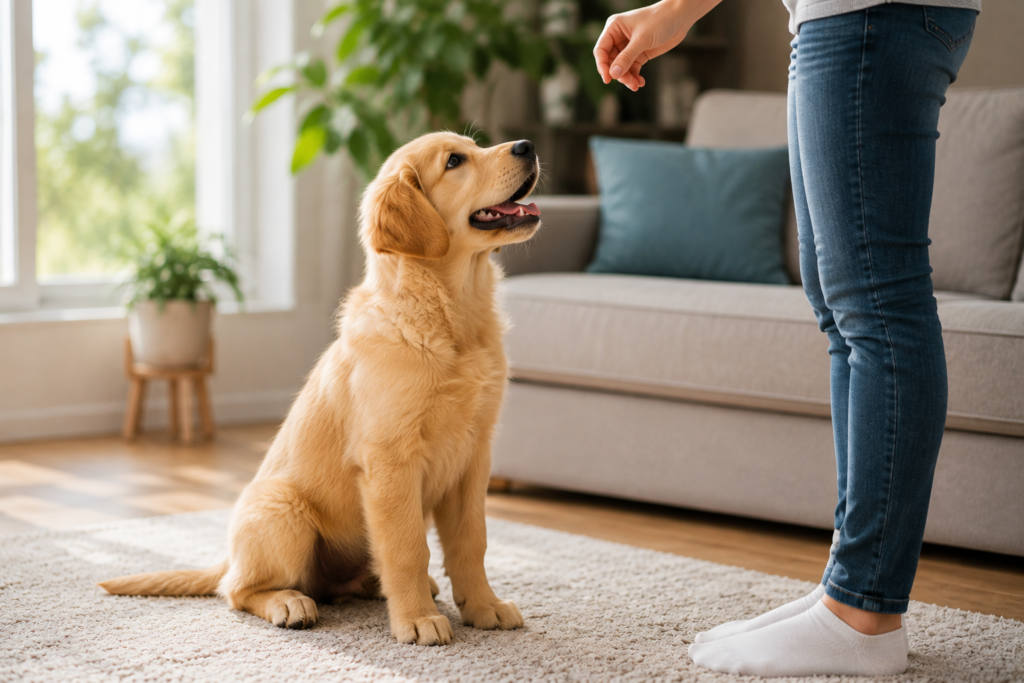
Start the day you bring your puppy home, even if that’s at eight weeks old. Formal obedience classes usually wait until a puppy has had enough vaccinations (typically around 10-12 weeks, depending on your vet’s guidance), but informal training can begin immediately.
Young puppies have a genuine learning window. Between roughly 3 and 14 weeks of age, puppies are especially open to new experiences, sounds, people, and other animals. This is prime time for socialization and for teaching the basics: name recognition, gentle handling, and simple cues like “sit.”
Quick guideline by age:
8-10 weeks: Name recognition, gentle handling, potty training routine begins 10-12 weeks: Basic commands (sit, come), crate training, controlled socialization 3-4 months: Leash walking, “stay,” bite inhibition refinement 4-6 months: Impulse control, longer commands, distraction training
Talk to your veterinarian about your specific puppy’s vaccination timeline before exposing them to dog parks or group classes, since protection against illnesses like parvovirus isn’t complete until the full vaccine series is done.
Essential puppy training tips for beginners
This is the core of it: the daily, practical stuff that actually shapes your puppy’s behavior. Let’s go through it piece by piece.
Start with your puppy’s name
Before “sit” or “stay,” your puppy needs to know its own name means “pay attention to me.” Say the name in a happy, upbeat tone, and the moment your puppy looks at you, mark it with a “yes!” and a treat.
Do this five or six times a session, a few times a day. Avoid using the name for scolding. If “Bella” only ever hears her name right before something unpleasant, she’ll start tuning it out. Keep it positive, always.
Positive reinforcement
This is the single most important concept in this entire guide. Positive reinforcement means rewarding behavior you want to see more of, with treats, praise, toys, or affection, rather than punishing behavior you don’t want.
Here’s why it works better than old-school correction methods: puppies trained with rewards learn faster, retain commands longer, and show fewer signs of fear or anxiety around their owners. Punishment-based methods, including yelling, leash jerks, or physical correction, are linked to increased aggression and fear in dogs. Every major veterinary and animal behavior organization, including the AVMA and AAHA, now recommends reward-based training as the standard.
How to do it well:
Reward within 1-2 seconds of the correct behavior, since timing matters more than most people realize Use small, high-value treats (pea-sized, soft, easy to chew quickly) Pair the treat with a verbal marker like “yes!” so your puppy connects the sound to the reward Gradually reduce treats once a behavior is reliable, replacing them with praise and occasional rewards
Pro tip: Keep a treat pouch clipped to your belt or a small bowl of training treats in every room your puppy frequents. You’ll never miss a good training moment because you had to go find snacks first.
House training
Potty training is usually the top concern for new owners, and it’s genuinely simpler than it feels in week one. The formula is consistency plus supervision plus a predictable schedule.
Basic house training routine:
Take your puppy outside first thing in the morning, after every meal, after naps, and after play sessions Pick one consistent potty spot and walk them there every time Praise enthusiastically and offer a treat the moment they go, not after you’re back inside Watch for signs like sniffing, circling, or sudden pausing during play, and take them out immediately Clean accidents with an enzymatic cleaner so lingering odor doesn’t invite repeat accidents in the same spot
Most puppies need to go out roughly every 1-2 hours as young pups, gradually extending as their bladder control develops. As a rough rule of thumb, a puppy can typically hold it for about one hour per month of age, up to a point.
Accidents will happen. Never rub your puppy’s nose in it or scold them after the fact. Dogs don’t connect punishment to something that happened minutes earlier, so it just teaches fear, not the lesson you’re going for.
Crate training
A crate isn’t a punishment box. Done right, it becomes your puppy’s personal den: a safe, quiet space they actually choose to retreat to. Crate training also speeds up potty training since most dogs won’t soil the space they sleep in.
Introducing the crate:
Make the crate cozy with a soft blanket and a safe chew toy Toss treats inside and let your puppy explore on their own terms; never force them in Feed meals near, then inside, the crate to build a positive association Start with short periods of the door closed while you’re in the room, gradually increasing duration Never use the crate as punishment for bad behavior
Most puppies can handle short crate stretches from day one, but avoid extended crating for very young puppies. Their bladders simply can’t hold it that long, and crying may mean a genuine need, not just protest.
Socialization
The socialization window (roughly 3-14 weeks) is when your puppy’s brain is most open to forming positive associations with new people, animals, sounds, and environments. Puppies who are well socialized during this period tend to grow into calmer, more confident adult dogs.
Ways to socialize safely:
Invite calm, vaccinated friendly dogs over for supervised play Expose your puppy to different surfaces (grass, tile, gravel, stairs) Introduce a variety of people: different ages, hats, beards, uniforms Play recordings of thunderstorms, vacuum cleaners, and traffic at low volume, increasing gradually Attend a reputable puppy socialization class once your vet gives the green light
Keep every new experience positive. If your puppy seems scared, don’t force it. Back off, go slower, and pair the scary thing with treats until it becomes neutral or even fun.
Bite inhibition
Puppies explore the world with their mouths, and nipping is completely normal, but it still needs boundaries. Bite inhibition training teaches your puppy to control the pressure of their mouth, which matters for the rest of their life.
When your puppy nips too hard during play, let out a sharp “ouch!” and stop playing for 10-15 seconds. This mimics how littermates teach each other bite pressure. Then redirect to an appropriate chew toy. Consistency here is everything. Every family member needs to respond the same way.
Warning: Never use hitting, nose-tapping, or physical punishment to stop biting. These methods often escalate mouthiness or create fear-based aggression instead of solving the underlying behavior.
Leash training
A puppy that drags you down the street isn’t being defiant. It just hasn’t learned that pulling doesn’t get it anywhere faster. Start indoors or in your yard before tackling the neighborhood.
Getting started:
Let your puppy wear the leash indoors first, dragging it around under supervision to get used to the feeling Hold the leash loosely and reward your puppy for walking near you, not just when they’re perfectly at heel The instant the leash goes tight, stop walking completely, then wait for slack before continuing Keep early walks short, five to ten minutes is plenty for a young puppy Practice in low-distraction areas before working up to busy streets
Front-clip harnesses tend to reduce pulling more effectively than collars for puppies still learning leash manners.
Basic commands
Sit, stay, come, and down form the foundation of good manners and, more importantly, keep your dog safe in real situations, like stopping them before they bolt into a street.
Teaching “sit”: Hold a treat just above your puppy’s nose and slowly move it back over their head. As their head tilts up, their bottom naturally drops. The moment it touches the ground, say “yes!” and reward.
Teaching “come”: Start in a low-distraction space. Crouch down, say your puppy’s name plus “come” in an excited tone, and reward heavily when they reach you. Never call your puppy to you for something unpleasant, like nail trims or scolding. “Come” should always mean good things happen.
Teaching “stay”: Ask for a sit, hold your palm up, and reward after just one second of stillness. Gradually build duration and distance, always returning to reward rather than calling your puppy out of position.
Keep sessions short: five to ten minutes, a few times daily works better than one long, tiring session.
Prevent jumping
Jumping usually comes from excitement, not disrespect, but it’s still worth curbing before your puppy is 60 pounds and greeting toddlers face-first.
The fix is simple but requires patience: never reward jumping with attention, even negative attention like pushing them off. Turn away, cross your arms, and ignore your puppy until all four paws are on the floor, then immediately reward the calm moment. Ask guests to do the same, and practice greetings on leash so you can guide your puppy into a sit before the front door even opens.
Prevent barking
Some barking is completely normal dog communication. Excessive barking, though, usually points to a specific trigger: boredom, anxiety, territorial instinct, or simply wanting attention.
Figure out the “why” first. A bored puppy needs more mental stimulation. An anxious puppy needs gradual desensitization to the trigger. A puppy barking for attention needs to learn that quiet, not noise, gets rewarded.
What actually helps:
Reward calm, quiet moments generously, especially when a trigger is present but your puppy stays settled Teach a “quiet” cue by waiting for a natural pause in barking, then marking and rewarding it Avoid yelling; to a puppy, that can sound like you’re joining in Address the root cause rather than just suppressing the symptom
Daily routine
Puppies thrive on predictability. A consistent daily rhythm for meals, potty breaks, naps, play, and training reduces anxiety and speeds up learning across the board, because your puppy starts to anticipate what comes next.
Sample daily rhythm:
Morning potty break immediately upon waking Breakfast, followed by another potty break Short training session (5-10 minutes) Nap Playtime and socialization Lunch, potty break Afternoon training session Supervised free time or a walk Dinner, potty break Evening wind-down and final potty break before bed
You don’t need to follow this to the minute, just aim for consistent spacing so your puppy’s internal clock can sync up with yours.
Mental stimulation
A tired puppy is a well-behaved puppy, but physical exercise alone doesn’t cut it. Mental stimulation, things like puzzle toys, sniffing games, and short training drills, tires out the brain, which is often more effective at preventing destructive behavior than an extra lap around the block.
Easy mental enrichment ideas:
Hide treats around a room for a sniff-and-find game Use a treat-dispensing puzzle toy at mealtime instead of a plain bowl Teach a new trick each week to keep sessions fresh Rotate toys weekly so nothing gets boring Practice “find it” games using scattered kibble in the grass
Common puppy training mistakes
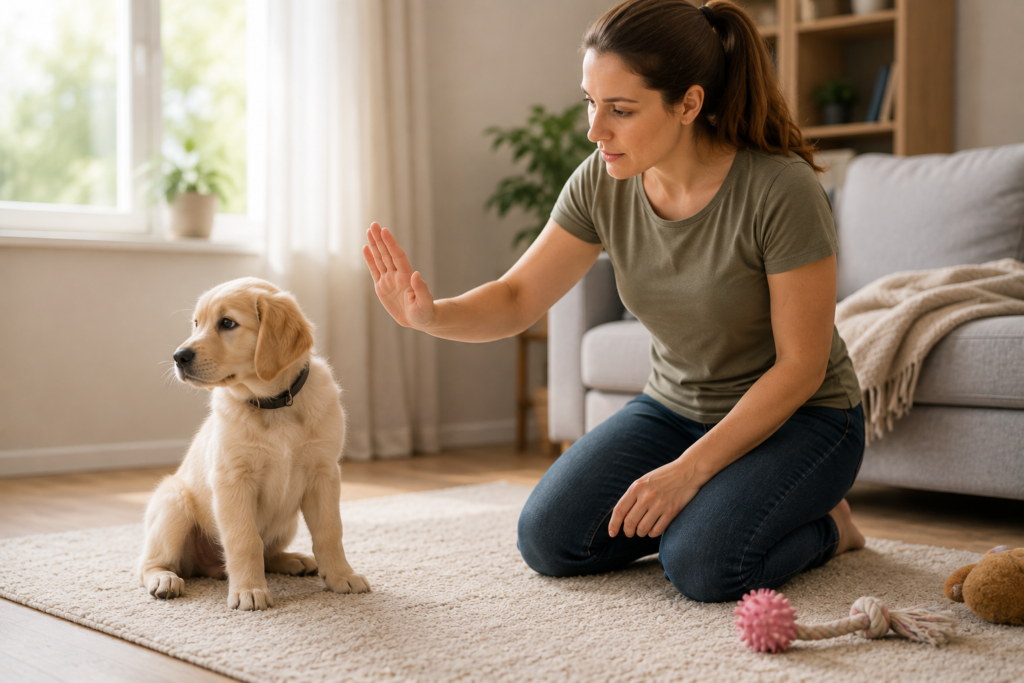
Even well-meaning owners fall into these traps. Recognizing them early saves a lot of frustration.
Inconsistency between family members: if one person allows the puppy on the couch and another doesn’t, the puppy gets mixed signals and learns nothing reliably Training sessions that are too long: puppies have short attention spans, and five to ten focused minutes beats thirty distracted ones Punishing behavior after the fact: a puppy can’t connect a scolding to something it did five minutes ago Skipping socialization out of caution: waiting too long to expose puppies to new experiences can create fearfulness later Expecting instant results: reliable behavior takes weeks of repetition, not a single session Using the crate as punishment: this undoes all the positive association you worked to build Rewarding calm behavior inconsistently: if your puppy only gets attention when they’re being wild, guess which behavior increases
Recommended training schedule
Here’s a sample weekly plan you can adapt to your puppy’s age and energy level.
| Week | Focus areas | Daily time commitment |
|---|---|---|
| Week 1 | Name recognition, house training routine, crate introduction | 10-15 minutes |
| Week 2 | Basic “sit,” gentle handling, continued potty consistency | 15 minutes |
| Week 3 | “Come,” bite inhibition, indoor leash practice | 15-20 minutes |
| Week 4 | “Stay,” controlled socialization, outdoor leash walks | 20 minutes |
| Week 5-6 | Combine commands, add distractions, begin “down” | 20-25 minutes |
| Week 7-8 | Practice in new environments, polish jump/bark control | 25-30 minutes |
Essential puppy training supplies
Having the right tools on hand from day one makes training noticeably smoother.
| Supply | Purpose | Beginner tip |
|---|---|---|
| Soft training treats | Rewarding correct behavior instantly | Choose pea-sized, low-calorie options to avoid overfeeding |
| Front-clip harness | Reduces pulling during leash training | Easier on the neck than a collar for enthusiastic pullers |
| 4-6 ft standard leash | Everyday walking and leash training | Avoid retractable leashes while training loose-leash walking |
| Wire or plastic crate | Safe space and potty training aid | Size it for your puppy’s adult size with a divider panel |
| Clicker | Marks the exact moment of correct behavior | Pair with treats for the first few weeks |
| Puzzle feeder | Mental stimulation and slower eating | Great for reducing boredom-based chewing |
| Enzymatic cleaner | Removes odor from potty accidents | Prevents repeat accidents in the same spot |
| Chew toys (variety) | Redirects nipping and teething | Rotate weekly to keep interest high |
Frequently asked questions
How long does it take to train a puppy? Basic commands like sit and come can be reliable within a few weeks of consistent practice, but full house training and solid manners typically take three to six months. Every puppy learns at a different pace.
What is the best age to start training a puppy? You can start informal training the day you bring your puppy home, often around eight weeks old. Formal classes usually begin around ten to twelve weeks, once your vet confirms it’s safe.
Should I use punishment if my puppy misbehaves? No. Reward-based, positive reinforcement training is the method recommended by veterinary and behavior professionals. Punishment can create fear, anxiety, and even aggression rather than solving the underlying issue.
How many times a day should I train my puppy? Aim for two to three short sessions daily, each around five to ten minutes. Short, frequent sessions hold a puppy’s attention far better than one long session.
Why does my puppy forget commands it already knew? This is completely normal. Puppies need repetition across different environments and distraction levels before a command becomes truly reliable. Keep practicing in new places.
Is crate training cruel? Not when it’s done correctly. A crate introduced gradually and positively becomes a safe den your puppy chooses to use, not a place of confinement or fear.
When should I contact a professional trainer or veterinarian? If you’re seeing signs of fear, aggression, extreme anxiety, or if basic training isn’t progressing after consistent effort, it’s worth consulting a certified professional dog trainer or your veterinarian to rule out underlying medical or behavioral issues.
How do I stop my puppy from chewing furniture? Puppy-proof the space, supervise closely, and redirect chewing to appropriate toys every time you catch them mid-act. Puppies chew more during teething, so offering a frozen chew toy can help soothe sore gums.
Final thoughts
Learning solid puppy training tips for beginners isn’t about perfection. It’s about showing up consistently, staying patient through the setbacks, and celebrating the small wins along the way. Some days your puppy will nail every command. Other days they’ll forget “sit” exists the moment a squirrel shows up. Both are completely normal.
Stick with positive reinforcement, keep your sessions short and upbeat, and lean on your veterinarian or a certified trainer if you hit a wall you can’t solve alone. That consistency now is what turns a chaotic eight-week-old puppy into a dog you can actually take anywhere.
(Visit: https://petnestcorner.com/)



2 Comments
How Do I Keep My Dog From Digging? 10 Practical Ways to Stop Yard Digging · September 8, 2026 at 08:27
[…] before it becomes deeply established. If you’re working through this with a young dog, our puppy training tips for beginners guide covers the foundational training that makes redirection […]
Best Pet Insurance for Dogs 2026: Complete Comparison Guide · September 26, 2026 at 08:03
[…] formally excluded under that insurer’s terms. If you’re bringing home a new puppy, our puppy training tips for beginners guide covers the other early-life basics worth planning […]