Beginner Guide to Fish Tank Setup
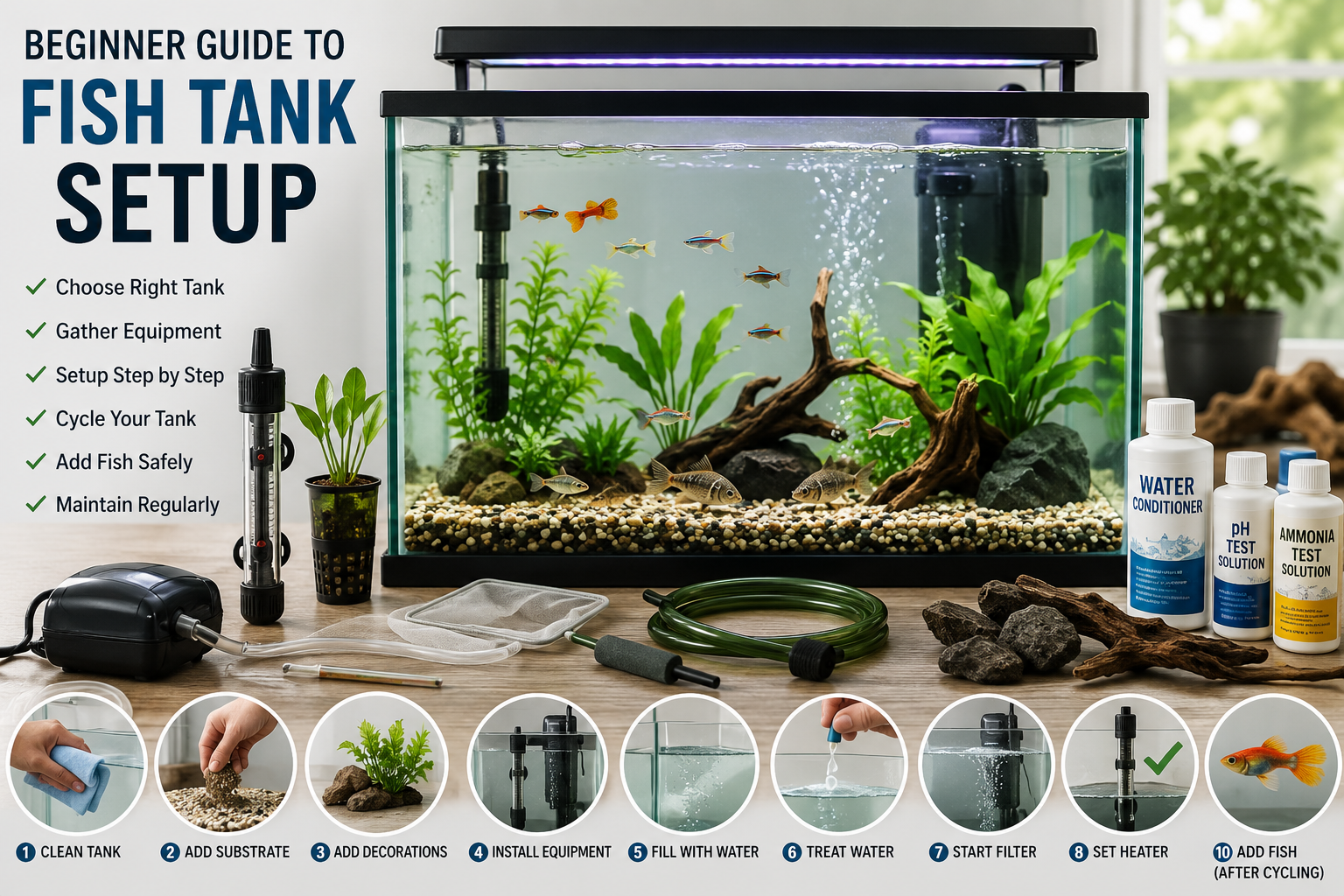
Beginner Guide to Fish Tank Setup: Start Your Aquarium Journey the Right Way
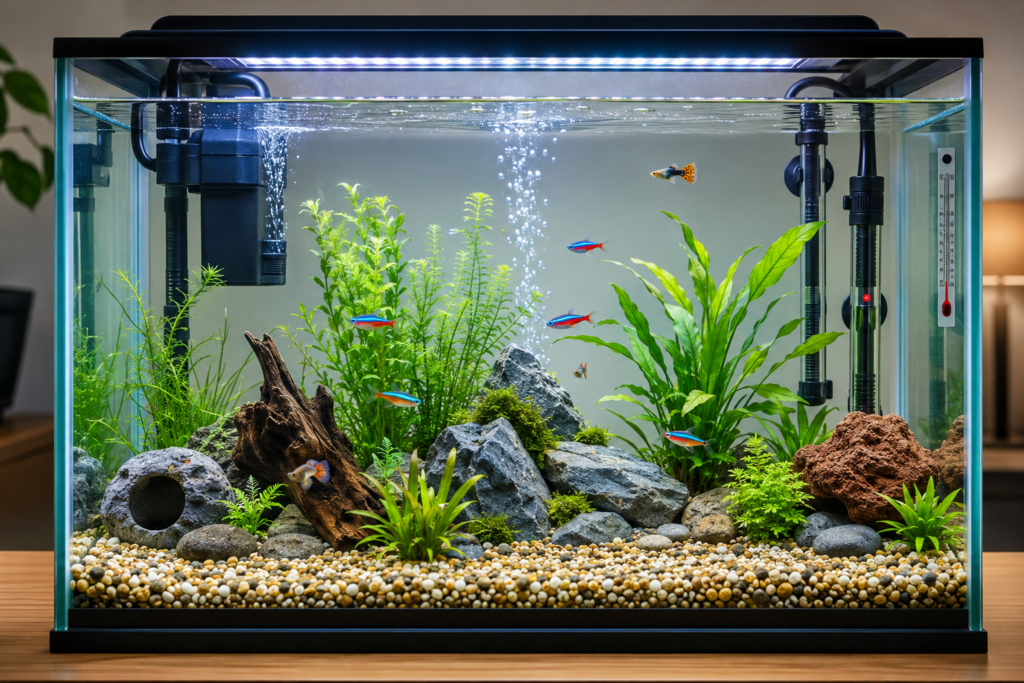
Starting a fish tank feels exciting and a little intimidating if you’ve never done it before. The good news? Setting up your first aquarium is actually straightforward when you know what to do.
I’ve watched countless people bring their first tank home and make it work beautifully. Some mistakes happen along the way (that’s normal), but the basics are simple enough that any beginner can master them in a single afternoon.
This guide walks you through every step of setting up a beginner-friendly fish tank. You’ll learn what equipment you actually need, how to prepare your water, why the nitrogen cycle matters, and which fish do best for newcomers. By the end, you’ll have the confidence to set up a healthy, thriving aquarium that your fish will love.
Whether you want a small desktop tank or a larger display, this guide covers it all. If you’re weighing fish against other low-maintenance pets, you might also enjoy our indoor rabbit care guide for comparison.
CHOOSING THE RIGHT FISH TANK
The tank itself is your foundation. Get this choice right, and everything else becomes easier.
Tank Size Matters More Than You Think
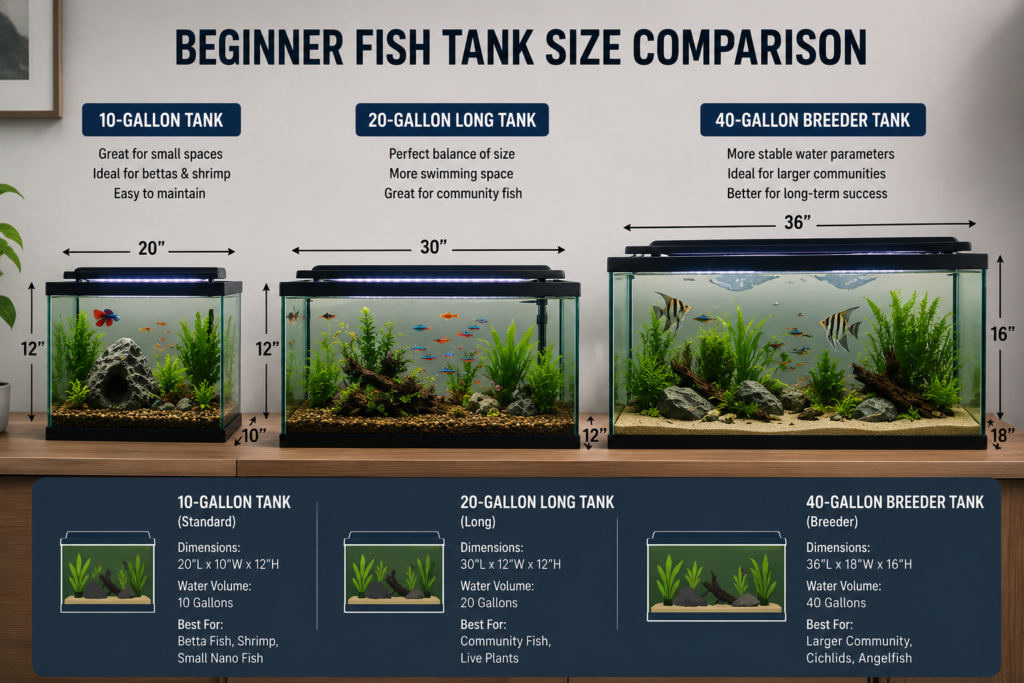
Beginners often assume smaller tanks are easier to maintain. They’re actually harder. Small tanks have less water volume, which means temperature swings and water quality problems happen faster and more dramatically. A 5-gallon tank can swing 10 degrees in hours. A 20-gallon tank is much more stable.
Here’s my recommendation: Start with a 20-gallon tank as an absolute minimum. A 20-gallon long (30 inches × 12 inches × 12 inches) gives you enough space to see real fish behavior, room for multiple fish species, and enough water volume to forgive beginner mistakes.
If you want something smaller for space reasons, 10 gallons can work, but expect a steeper learning curve. Anything under 5 gallons is really not suitable for a beginner’s first setup.
If you have the space, 40-gallon breeders (36 inches × 18 inches × 18 inches) or standard 55-gallons are fantastic beginner tanks. More water volume means more stability and less frequent maintenance.
Glass vs. Acrylic Tanks
Glass tanks are the standard choice. They’re affordable, scratch-resistant, and won’t yellow over time. The downside? They’re heavy and they crack if you drop them.
Acrylic tanks are lighter and more shatter-resistant, but they scratch easily and can yellow after years of exposure to light. Acrylic is also more expensive. For most beginners, glass is the better choice.
Starter Aquarium Kits
Many stores sell all-in-one kits. These sound convenient, and some are decent, but many include undersized filters, weak lighting, and low-quality heaters. If you buy a kit, make sure the filter is rated for at least the tank’s volume (ideally higher), and check that the heater wattage matches your tank size.
A better approach? Buy your tank and equipment separately. You’ll spend about the same money but end up with higher-quality components.
ESSENTIAL FISH TANK EQUIPMENT
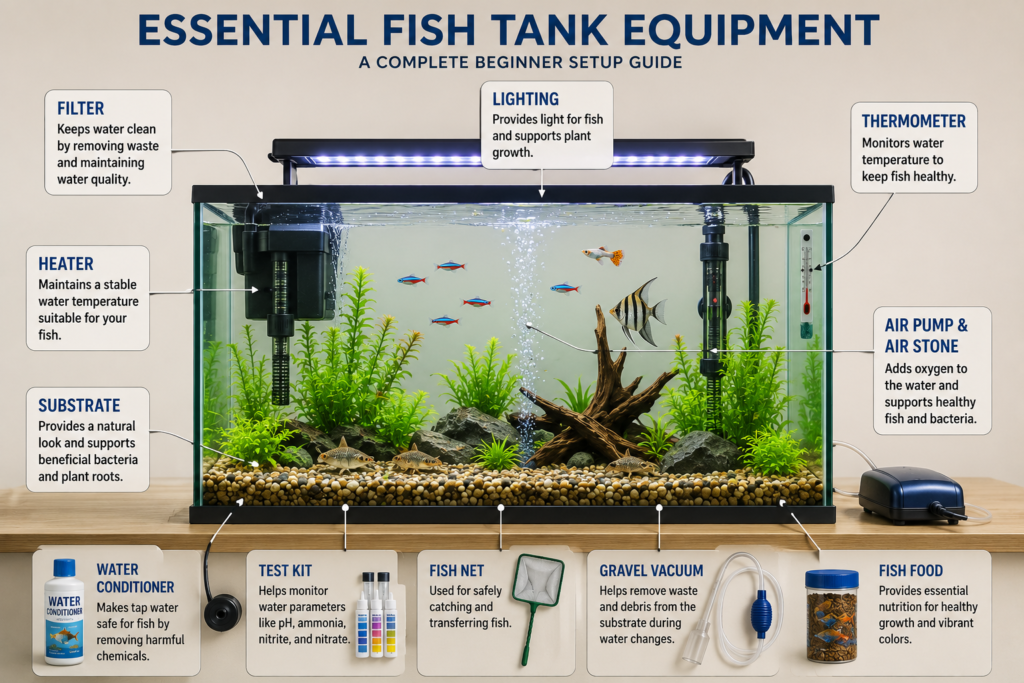
Before filling your tank, gather these items. Each one serves a specific purpose, and skipping any creates problems down the line.
Aquarium Filter
The filter is your tank’s life support system. It removes waste, prevents ammonia buildup, and circulates water to distribute oxygen and nutrients.
Why it matters: Fish produce ammonia through their gills and waste. Without a filter, ammonia reaches toxic levels in hours. A good filter physically removes solid waste while also providing a surface for beneficial bacteria to colonize.
Types of filters:
- Hang-on-back (HOB) filters are affordable, easy to maintain, and work well for beginners. They fit on the back of your tank.
- Canister filters are powerful and hide under your stand, but they’re more expensive and require more maintenance.
- Sponge filters are cheap and reliable, perfect for smaller tanks.
Choose a filter rated for at least your tank’s volume, ideally 10% higher. A 20-gallon tank should have a filter rated for 20-40 gallons per hour (GPH).
Aquarium Heater
Most community fish need 76–78°F to thrive. Room temperature usually isn’t warm enough.
Why it matters: Fish are ectothermic (cold-blooded). Without stable warmth, their metabolism slows, their immune system weakens, and they become stressed and sick.
For a 20-gallon tank, get a 100-150 watt heater. For every 10 gallons, add roughly 50 watts. Buy one with an adjustable thermostat so you can dial in the exact temperature.
Thermometer
You need to know your water temperature. A simple stick-on thermometer works fine for beginners, but a floating glass thermometer or digital thermometer is more accurate. Check it daily until your heater stabilizes the temperature.
Aquarium Lighting
Most tanks come with basic LED lighting, which is fine for viewing your fish. If you plan live plants, you’ll need stronger lighting (full-spectrum LEDs are ideal).
Why it matters: Fish need light to see, and a natural day-night cycle keeps their behavior normal. Most tanks need 8-12 hours of light per day.
Air Pump (Optional But Useful)
An air pump creates air stones that add oxygen and create water movement. It’s not essential if your filter already creates good surface agitation, but it’s cheap insurance and helps during power outages.
Water Conditioner
Tap water contains chlorine and chloramine, which are toxic to fish. A water conditioner neutralizes these chemicals instantly when you add it to the water.
Why it matters: Never put untreated tap water in your tank. Always condition it first.
Gravel Vacuum
A gravel vacuum (also called a siphon or aquarium vacuum) removes waste from the substrate during water changes. This tool will become your best friend during maintenance.
Fish Net
You’ll need a net for moving fish or removing dead plants. Get a soft mesh net that won’t damage fish scales.
Water Test Kit
Understanding your water parameters is crucial. Get a liquid test kit (not paper strips) that tests ammonia, nitrite, nitrate, and pH. Paper strips are unreliable.
Why it matters: Testing your water tells you when your tank has cycled and alerts you to problems before fish die.
Fish Food
Quality food matters. Avoid those tiny containers at the pet store. Buy premium flakes or pellets (brands like Tetra or Omega One are solid). Feed sparingly—fish actually need less food than beginners think.
CHOOSING THE BEST LOCATION
Where you place your tank matters more than many beginners realize. A poor location creates constant headaches.
Avoid Direct Sunlight
Direct sunlight causes algae explosions. Even a few hours daily through a window can turn your tank green in weeks. Place your tank against a wall away from windows, or use a curtain to block direct rays.
Find a Stable, Level Surface
Your tank needs absolutely level, stable support. An uneven surface stresses the frame and can cause leaks. A dedicated aquarium stand is ideal. Whatever you use, make sure it can handle the weight (a 20-gallon tank weighs about 250 pounds when full).
Locate Nearby Electrical Outlets
You need outlets for your filter, heater, and lights without using extension cords that cross walkways. Plan this before setting up.
Keep Temperature Stable
Avoid placing your tank near heating vents, air conditioning units, or doors that open to the outside. Temperature fluctuations stress fish and stress your heater.
Keep It Safe and Accessible
Make sure your tank isn’t in a high-traffic area where it could get knocked over. Also, ensure you can comfortably reach it for maintenance and feeding.
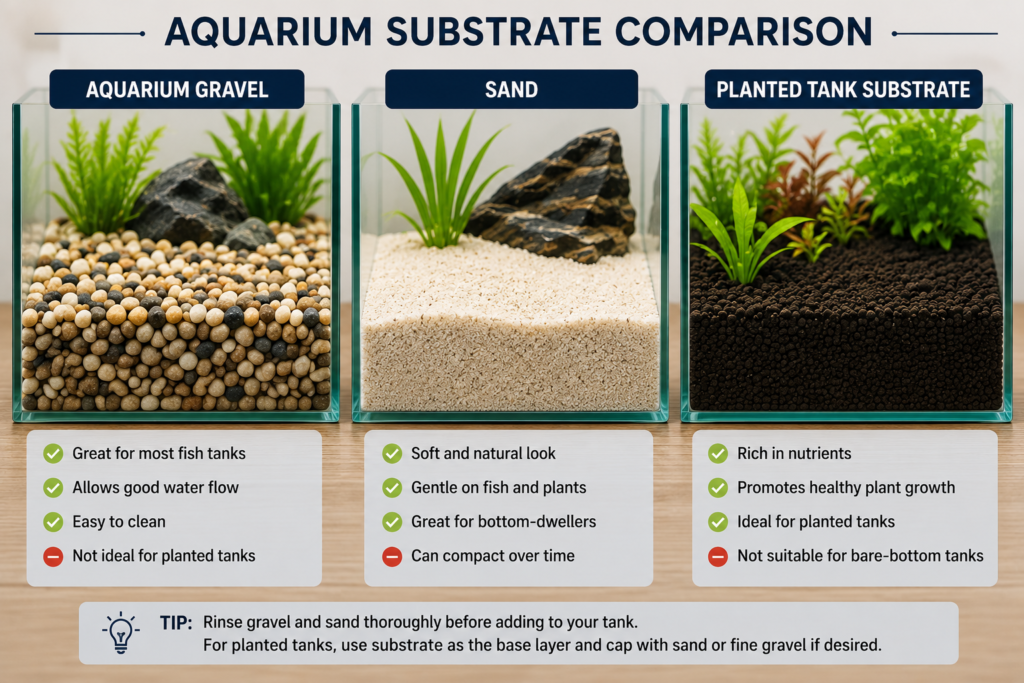
CHOOSING THE RIGHT SUBSTRATE
Substrate is the material on the bottom of your tank. It’s not just decoration—it’s crucial for your aquarium’s ecosystem.
Aquarium Gravel
Standard aquarium gravel is colorful, affordable, and easy to clean. It comes in various sizes and colors.
Pros: Cheap, available everywhere, looks good, works with most fish species, beneficial bacteria colonize it well.
Cons: Debris collects between rocks and gets hard to vacuum, smaller gravel can be swallowed by bottom feeders, standard gravel doesn’t provide nutrients for plants.
Sand
Sand is increasingly popular, especially for tanks with bottom-dwelling fish like Corydoras catfish.
Pros: More natural-looking, easier to clean than gravel, better for bottom feeders, plants thrive in sand, looks beautiful.
Cons: More expensive, can compact and create dead zones, requires a thicker layer (4+ inches), takes longer to vacuum.
Planted Tank Substrate
Specialized substrates designed for planted tanks contain nutrients that roots absorb.
Pros: Promotes plant growth, looks natural, helps establish healthy root systems.
Cons: More expensive, requires more maintenance, can cloud water initially, overkill for fish-only tanks.
My Recommendation
Start with quality aquarium gravel. It’s affordable, reliable, and works great for beginner tanks. Use about 1.5 to 2 pounds per gallon (so 30-40 pounds for a 20-gallon tank).
ADDING DECORATIONS AND PLANTS
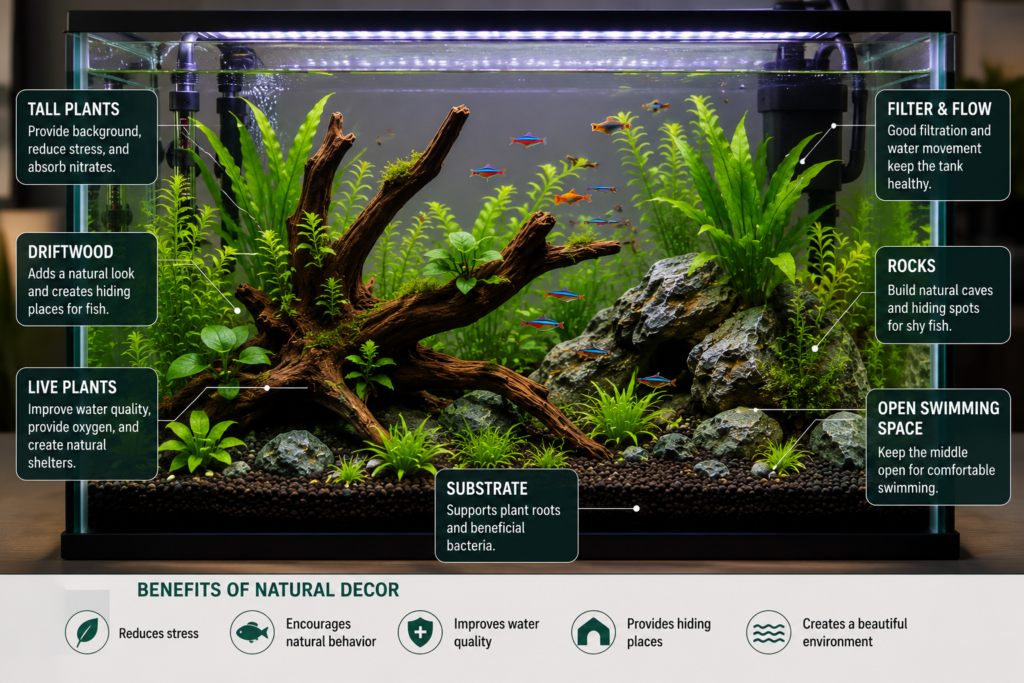
Decorations do more than look pretty. They provide shelter, reduce stress, and make your tank feel like a real environment rather than a glass box.
Rocks
Natural rocks add visual interest and create hiding places. Use smooth rocks (avoid sharp edges that tear fish fins). Rinse rocks thoroughly before adding them. Avoid limestone or rocks that crumble easily.
Driftwood
Driftwood looks stunning and fish love hiding in it. Make sure it’s aquarium-safe (most pet store driftwood is). New driftwood can leach tannins that turn water tea-colored. Boil it first or let it soak for a week to minimize this.
Artificial Plants
Plastic plants require zero maintenance and won’t be uprooted by fish. They don’t improve water quality like live plants do, but they provide shelter and reduce light reflection.
Live Plants
Live plants actively improve water quality by consuming nitrate and producing oxygen. They also provide natural shelter and look beautiful. Easy beginner plants include Java fern, Anubias, and Amazon sword. Roots or rhizomes should not be buried in substrate.
Fish Hiding Places
Create at least one hiding place per fish. Fish feel vulnerable in open water. A hiding place reduces stress and helps them feel secure. Use caves, dense plants, or PVC tubes.
HOW TO SET UP A FISH TANK STEP-BY-STEP
Now let’s build your tank. Follow these 10 steps in order.
Step 1: Clean the Tank Thoroughly
Rinse the inside of the tank with warm water only—no soap or chemicals. Wipe the glass to remove dust. Rinse again until it’s spotless. Soap residue poisons fish, so be thorough.
Step 2: Add Your Substrate
Rinse your gravel or sand until the water runs clear. This removes dust and debris. Pour the rinsed substrate into the tank, creating an even layer about 2 inches deep. Level it out with your hand.
Step 3: Place Decorations and Plants
Now arrange your rocks, driftwood, and plants. Position them before filling with water, so you don’t disturb them later. Live plants’ roots or rhizomes should sit just on the substrate surface, not buried.
Step 4: Install All Equipment
Mount your filter on the back of the tank (or place your canister filter under the stand). Install the heater in a visible location where water can flow around it. Place your thermometer where you can easily read it. Add your air stone and airline tubing if you’re using an air pump.
Don’t plug anything in yet—just assemble it.
Step 5: Fill the Tank With Water
Place a bowl on top of the substrate and pour water slowly over it. This prevents the substrate from swirling and clouding the water. Fill the tank about 3/4 full. You’ll top it off later after the equipment is running.
Step 6: Treat Your Water
Once the tank is mostly full, add water conditioner according to the bottle’s instructions. Stir gently to distribute it evenly. This neutralizes chlorine and chloramine immediately.
Step 7: Start the Filter
Plug in the filter and let it run. You might hear air bubbles escaping—this is normal. The filter should draw water through its media and create a gentle current.
Step 8: Set Your Heater to Target Temperature
Set the heater to 76–78°F and plug it in. Give it 2-3 hours to warm the water. The heater cycles on and off to maintain that temperature. Check the thermometer regularly until it stabilizes.
Step 9: Turn On Lighting
Plug in your lighting on a timer. Set it for 8-10 hours daily. This mimics a natural day-night cycle that fish need.
Step 10: Check All Equipment
Walk through everything one more time. Is the filter running? Is water flowing? Is the heater warming the tank? Are lights on? Is the air pump bubbling (if you have one)? Good—everything should be running smoothly.
Top off the water to the fill line (usually an inch below the rim). You’re done with the physical setup.
UNDERSTANDING THE NITROGEN CYCLE
This is the most important concept in the entire guide. Master this, and you’ll understand why fish die in poorly maintained tanks.
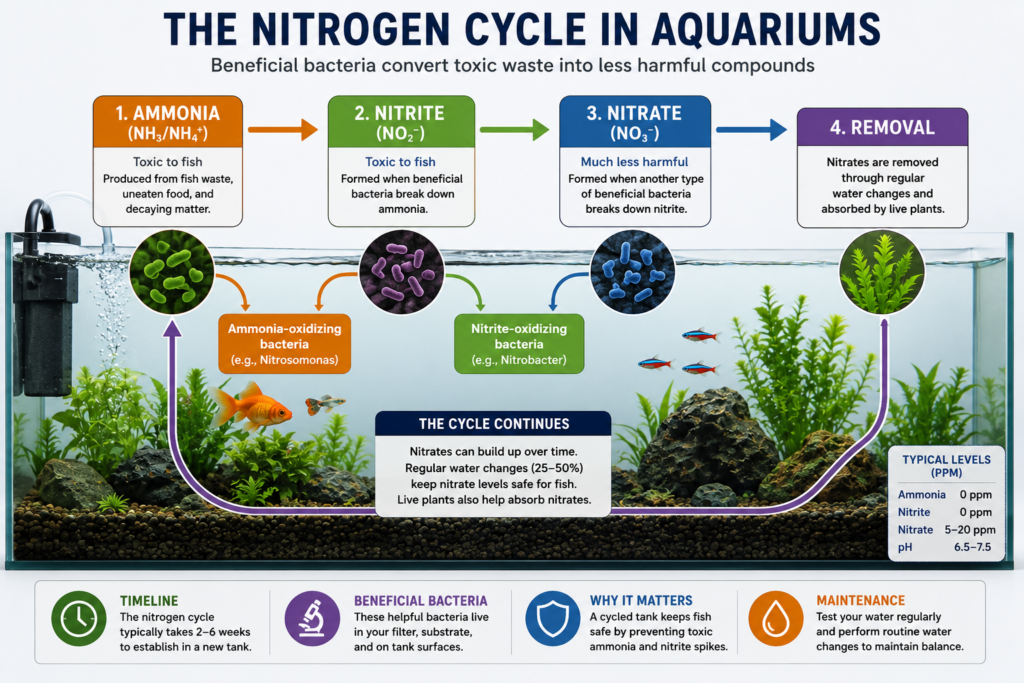
Fish produce waste. That waste contains ammonia, which is extremely toxic. Without beneficial bacteria to break it down, ammonia kills fish quickly.
Beneficial bacteria (primarily Nitrosomonas and Nitrobacter) establish themselves in your filter and substrate. They break ammonia down into nitrite (also toxic), which is then converted to nitrate (relatively harmless to fish in normal levels). This process is called the nitrogen cycle.
The Cycle Explained
Ammonia (NH₃) comes from fish waste and uneaten food. Beneficial bacteria convert ammonia to nitrite.
Nitrite (NO₂) is the intermediate product—also highly toxic to fish, though slightly less than ammonia. Beneficial bacteria convert nitrite to nitrate.
Nitrate (NO₃) is the final product. It accumulates in your tank but rarely reaches dangerous levels unless you never do water changes. Regular water changes keep nitrate manageable.
Why Cycling Matters
A cycled tank handles fish waste without toxin spikes. An uncycled tank lets ammonia and nitrite accumulate until they poison your fish. Most beginner fish deaths happen in uncycled tanks within the first two weeks.
Fishless Cycling (Recommended)
Fishless cycling establishes bacteria without using fish as test subjects. This method is more humane and gives you more control.
How it works:
- Add ammonia source to the tank (pure ammonia, fish food, or store-bought ammonia)
- Test ammonia level daily
- When ammonia drops, add ammonia again
- Repeat until beneficial bacteria establish (4-8 weeks)
- Test nitrite and nitrate—they’ll appear as bacteria multiply
- When ammonia and nitrite both reach zero and nitrate appears, your tank is cycled
This takes patience, but it works. Many beginners find kits like Dr. Tim’s or Tetra SafeStart helpful—they add cultured bacteria to speed the process.
Cycling With Fish (Not Recommended)
Some people add fish before cycling to speed things up. The fish survive on partial water changes and luck, but many get sick. If you do this, do 50% water changes daily and test water religiously. It’s unnecessarily stressful for the fish.
Timeline
Fishless cycling typically takes 4-6 weeks. Some tanks cycle in 3 weeks; others take 8. Temperature and filter media affect speed. Warmer water speeds it up slightly. Reusing filter media from an established tank speeds it up dramatically.
TESTING WATER PARAMETERS
You can’t manage what you don’t measure. Testing your water is how you know your tank is healthy.
Essential Parameters
pH measures how acidic or alkaline your water is (0-14 scale). Most community fish prefer 6.5-7.5. Get a kit that tests the full range accurately.
Ammonia (NH₃) should always be zero in an established tank. Any ammonia means your bacteria aren’t keeping up or your tank isn’t cycled.
Nitrite (NO₂) should always be zero. Any nitrite indicates a cycling problem. Nitrite is nearly as toxic as ammonia.
Nitrate (NO₃) accumulates over time. It’s relatively safe at levels below 40 PPM, but high levels (over 80 PPM) stress fish. Regular water changes keep it under control.
Temperature should stay stable within your target range (usually 76-78°F). Fluctuations stress fish.
Water Parameter Ranges Chart
| Parameter | Ideal Range | Test Frequency |
|---|---|---|
| pH | 6.5–7.5 | Weekly |
| Ammonia | 0 PPM | Every 2-3 days (cycling), weekly (established) |
| Nitrite | 0 PPM | Every 2-3 days (cycling), weekly (established) |
| Nitrate | 5–40 PPM | Weekly |
| Temperature | 76–78°F | Daily |
Testing Frequency
During cycling: Test every 2-3 days to track progress.
Weeks 1-2 after adding fish: Test every other day to catch problems early.
After month 1: Test weekly to confirm stability.
Established tanks (3+ months): Test weekly or biweekly as routine maintenance.
If problems arise (fish acting sick, cloudy water), test daily until you resolve the issue.
The Right Test Kit
Liquid test kits (like API Master Kit) are accurate and affordable. They cost $25-35 but last months. Paper strip tests are cheaper but unreliable. Skip them.
CHOOSING BEGINNER-FRIENDLY FISH
Not all fish are suitable for beginners. Some are aggressive, some need massive tanks, others are extremely sensitive to water quality. Here are species that actually work for new aquarists.
Bettas
Hardy, beautiful, and tolerant of small tanks. Male bettas must be alone (they fight other males ferociously). Bettas do best in 5+ gallon tanks with a heater, though they survive in smaller volumes. They live 3-5 years.
Compatibility: Keep males alone. Females can sometimes be kept together (betta sororities), but this requires experience and often fails.
Guppies
Colorful, hardy, and affordable. Guppies are nearly impossible to kill. They’re small (males 1 inch, females 1.5 inches) and peaceful.
Compatibility: Males can be kept together, though they sometimes nip fins. Keep females separately or in groups if you have many.
Neon Tetras
Tiny, shimmering fish that look spectacular in groups. They need 10+ gallon tanks and prefer groups of 6+ for confidence. They’re hardy when water parameters are stable.
Compatibility: Peaceful schooling fish. Keep in groups.
Zebra Danios
Active, hardy fish that are nearly indestructible. They’re slightly aggressive, so don’t keep them with slow-moving fish like bettas.
Compatibility: Best kept in groups of 5+. Can be aggressive with slower species.
Corydoras Catfish
Bottom-dwelling scavengers that eat fallen food, reducing waste. They’re peaceful and become quite personable. They need sand or fine gravel (coarse gravel can damage their barbels).
Compatibility: Peaceful. Keep in groups of 3+ for best behavior.
Mollies
Hardy, peaceful, and tolerant of various water conditions. They’re slightly larger (2-3 inches) and more aggressive than guppies but less aggressive than danios.
Compatibility: Peaceful schooling fish. Keep in groups.
Platies
Peaceful, colorful, and extremely hardy. Platies look similar to guppies but are slightly larger and hardier. They’re one of the best beginner fish.
Compatibility: Peaceful. Can be kept alone or in groups.
Cherry Barbs
Small, peaceful barbs with beautiful red coloring (especially males). They’re less common than other beginner species but worth seeking out. They need 20+ gallons and groups of 5+.
Compatibility: Peaceful. Keep in groups.
Beginner Fish Comparison Table
| Species | Tank Size | Group Size | Hardiness | Lifespan | Special Needs |
|---|---|---|---|---|---|
| Betta | 5 gallons | 1 (males) | Very Hardy | 3-5 years | Heater, male isolation |
| Guppy | 10 gallons | 5+ | Very Hardy | 2-3 years | None |
| Neon Tetra | 10 gallons | 6+ | Hardy | 3-5 years | Groups, stable water |
| Zebra Danio | 20 gallons | 5+ | Very Hardy | 3-5 years | Groups, space |
| Corydoras | 20 gallons | 3+ | Hardy | 3-5 years | Sand substrate |
| Molly | 20 gallons | 3+ | Very Hardy | 3-5 years | None |
| Platy | 20 gallons | 3+ | Very Hardy | 3-5 years | None |
| Cherry Barb | 20 gallons | 5+ | Hardy | 4-5 years | Groups |
ADDING FISH SAFELY
Adding fish to a new tank is exciting, but rushing causes problems. Take your time and acclimate fish properly.
Why Acclimation Matters
Fish in pet stores live in different water conditions than your tank—different pH, temperature, and chemistry. Dropping them directly into your tank shocks their system. Proper acclimation prevents stress and death.
The Floating Bag Method
- Float the unopened bag on your tank water for 15-20 minutes to equalize temperature
- Open the bag and carefully roll the top edge down to create an air space
- Slowly add a few spoonfuls of your tank water to the bag every 5 minutes
- After 30-45 minutes, the water in the bag will match your tank’s chemistry
- Gently pour the fish into the tank, discarding the bag water (don’t pour store water into your tank)
Drip Acclimation (More Thorough)
For sensitive fish or delicate species:
- Float the bag like above
- Set up an airline tube with an air valve
- Start a siphon from your tank into the bag (the air valve controls flow)
- Run water into the bag at 1-2 drips per second for 2-3 hours
- Net the fish out and gently place it in the tank
Drip acclimation is safer but takes longer. Use it if you’re unsure.
Avoid Overstocking
More fish doesn’t mean better. Overstocked tanks become toxic quickly, and fish become stressed. Follow these stocking guidelines:
- 1 inch of fish per gallon (so a 20-gallon tank supports 20 inches of fish)
- Some bottom feeders and plecos don’t count fully in this calculation
- Better to understock than overstock
A common beginner mistake: buying one fish each week, not realizing the tank becomes dangerously overstocked. Add a few fish, wait a month, then add more.
FISH TANK MAINTENANCE
Regular maintenance keeps your tank healthy and your fish thriving. It’s not difficult—it just needs to be consistent.
Daily Maintenance
- Feed fish once or twice daily, only enough that they finish in 2-3 minutes
- Check temperature with your thermometer
- Watch your fish for signs of illness or stress (unusual color, torn fins, gasping)
- Ensure equipment is running (filter, heater, lights)
Weekly Maintenance
- Test water parameters (ammonia, nitrite, nitrate, pH)
- Do a 25% water change (remove 25% of the water, replace with fresh conditioned water)
- Clean the filter (rinse in old tank water if it needs it, not tap water)
- Remove uneaten food and dead plants or algae
- Vacuum substrate to remove waste
Monthly Maintenance
- Check all equipment for signs of wear
- Clean tank glass if algae is building up
- Trim live plants if they’re overgrowth
- Deep clean decorations if they’re covered in algae
- Review maintenance records (keep a simple log of water parameters)
Weekly Maintenance Checklist
| Task | Frequency | Time Required |
|---|---|---|
| Test water parameters | Weekly | 10 minutes |
| 25% water change | Weekly | 15 minutes |
| Feed fish | Daily | 2 minutes |
| Check temperature | Daily | 1 minute |
| Vacuum substrate | Weekly | 15 minutes |
| Clean filter (rinse media) | Every 2-3 weeks | 5 minutes |
| Remove dead plants/food | Weekly | 5 minutes |
| Clean glass | Weekly (if needed) | 10 minutes |
COMMON BEGINNER MISTAKES (AND HOW TO AVOID THEM)
Learning from others’ mistakes saves you time, money, and heartbreak.
Overfeeding Fish
The number one killer of fish. Fish don’t need much food. Overfeeding leads to uneaten food rotting at the bottom, causing ammonia spikes that poison fish.
The fix: Feed once or twice daily, only amount that gets eaten in 2-3 minutes. Your fish won’t starve on less—they actually prefer gentle underfeeding to overstuffing.
Overstocking the Tank
Beginners often add too many fish too quickly. Fish waste accumulates faster than bacteria can process it, causing ammonia and nitrite spikes.
The fix: Follow the 1-inch-per-gallon rule. Add a few fish, wait a month, add more. This lets bacteria populations keep up with the bioload.
Skipping the Cycling Process
Impatient beginners add fish immediately to uncycled tanks, then wonder why the fish die in a week.
The fix: Cycle your tank first, using either the fishless method or by doing daily water changes if you must add fish. This takes 4-6 weeks but saves fish lives.
Not Testing Water Regularly
You can’t see ammonia, nitrite, or pH problems. Many beginners ignore testing until fish are already dying.
The fix: Test weekly, especially in the first month. Testing takes 10 minutes and prevents disaster.
Cleaning the Filter With Tap Water
Tap water chlorine kills the beneficial bacteria in your filter. Beginners often restart their cycle accidentally by cleaning the filter wrong.
The fix: Rinse filter media in old tank water (water from your tank, not fresh water). This preserves bacteria while removing debris.
Wrong Fish Combinations
Some fish are aggressive, some need different temperatures, some eat others. Mixing incompatible species leads to stress and death.
The fix: Research before buying. Check compatibility online. Ask experienced aquarists. Stick to species from this guide initially.
Poor Maintenance Habits
Skipping water changes, forgetting to feed, ignoring cloudiness—these compound into disaster.
The fix: Schedule maintenance. Set a phone reminder. Keep a maintenance log. Make it routine, like brushing your teeth.
MONEY-SAVING TIPS FOR BEGINNER AQUARISTS
Quality equipment doesn’t have to be expensive. Here are ways to save without sacrificing your fish’s health.
Buy Used Equipment
Facebook Marketplace, Craigslist, and local aquarium groups often have used tanks, filters, and heaters. A used tank is just as good as new (glass doesn’t wear out). Inspect for cracks or leaks, but used equipment is typically reliable and saves 30-50%.
Buy Dry Goods in Bulk
Food, water conditioner, and substrate are cheaper in larger quantities. Buy the largest size you’ll use in 6 months.
DIY Decorations
Rocks from nature (rinsed thoroughly), branches from your yard, and PVC pipes cost pennies. Pet store decorations marked up 300%. Nature is free.
Skip Premium Food
Quality food matters, but you don’t need the most expensive brands. Mid-range brands (Tetra, Omega One, Hikari) are excellent and cost less than premium brands.
Join Local Aquarium Clubs
Aquarium clubs often trade or sell fish, plants, and equipment at cost. You’ll also get free advice from experienced aquarists.
Buy Fish Locally
Local breeders and aquarium clubs often sell fish cheaper than pet stores, with healthier stock.
DIY Siphon
You can make a gravel vacuum from airline tubing and a PVC pipe. YouTube has dozens of tutorials. Cost: $3. Store-bought: $20.
FREQUENTLY ASKED QUESTIONS
How long should a fish tank cycle?
Typically 4-6 weeks. Some tanks cycle in 3 weeks if conditions are ideal (warm temperature, established filter media). Others take 8 weeks if the temperature is cold. Test your water every 2-3 days to know when it’s done (ammonia and nitrite both reach zero while nitrate appears).
How many fish should beginners keep?
Start small. A 20-gallon tank can comfortably hold 15-20 small fish. But beginners should start with 5-10 and add more after a month. This prevents overstocking and gives you time to learn maintenance.
Do fish need a heater?
Yes, for tropical community fish (which are best for beginners). Room temperature (usually 70-72°F) is too cold. Fish metabolism slows, they stop eating, and disease strikes. A heater is one of the cheapest investments you’ll make and prevents most beginner problems.
How often should I change the water?
Weekly, 25% water change. This removes nitrate buildup and replenishes minerals. If your tank is overstocked, do 50% weekly. If you have very few fish in a large tank, you might stretch it to every 10 days, but weekly is safer for beginners.
Can I use tap water?
Never directly. Tap water contains chlorine and chloramine that kill fish instantly. Always use a water conditioner. Some conditioners also detoxify heavy metals and ammonia, which is even better.
What size tank is best for a beginner?
20 gallons. It’s large enough to be forgiving of mistakes, small enough to fit in most homes, and affordable. 10 gallons can work if space is limited, but 20 is better.
How long do aquarium filters run?
24/7. Turn them off only during maintenance or emergencies. Bacteria in the filter need constant water flow to survive. Turning the filter off regularly kills bacteria and destabilizes your tank.
Should aquarium lights stay on all day?
No. Fish need 8-12 hours of light daily and 12-16 hours of darkness. Too much light (over 12 hours) causes excessive algae. Too little (under 8 hours) causes fish stress and behavior problems. A simple timer takes the guesswork out of this.
Can live plants improve water quality?
Yes. Live plants consume nitrate (they need it for growth), produce oxygen, and provide shelter. Even a few easy plants like Java fern make a measurable difference. But they’re not a replacement for water changes.
How often should substrate be cleaned?
Weekly. Use a gravel vacuum during your water change to remove waste and uneaten food from the substrate. You don’t need to remove the substrate—just siphon the top layer.
What do I do if my fish get sick?
First, test your water (most “sickness” is actually poor water quality). If parameters are off, do a 50% water change immediately. If your fish are still sick and water is fine, isolate them in a separate tank if possible and research the specific illness. Common beginner fish rarely get actual diseases if water quality is maintained.
Is the nitrogen cycle really that important?
Yes. This is the single most important concept in aquarium keeping. A cycled tank with good bacteria handles fish waste. An uncycled tank accumulates toxins that kill fish. Respect the cycle.

1 Comment
Indoor Rabbit Care Guide: Housing, Diet & Health Tips · September 5, 2026 at 13:26
[…] advice that actually works. If you’re also considering other small pets, take a look at our beginner fish tank setup guide for […]